



Learning Before the Lectures
Before I attended university, I worked for four years – first in a corporate clerical role, then in social services. These early jobs immersed me in real-world problem-solving, teamwork and decision-making. I was learning by doing – active, engaged and constantly adapting.
Then came university. Long before computers and the internet, we were told to “read for a degree.” That phrase says it all. My education became passive, solitary and abstract.
I earned a degree, but not the kind of insight or practical understanding that had come from real-world experience. That contrast – between doing and reading, engagement and isolation – shaped my view of what education should be.
 The Power of Active, Experience-Based Learning
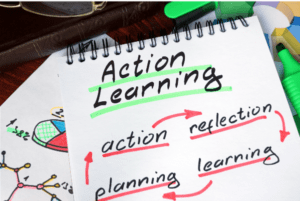 The Power of Active, Experience-Based Learning
Active learning is grounded in direct engagement. It is personal, social and immediate. It demands participation and decision-making. Whether in the workplace or classroom, it builds confidence and character alongside knowledge.
Advantages of Experience-Based Learning
- Real-world relevance – Learners face meaningful problems and make practical decisions.
- Social intelligence – Communication, leadership and teamwork are continuously developed.
- Immediate feedback – Outcomes are visible. Successes and failures are part of the learning loop.
- Intrinsic motivation – Purpose and relevance drive sustained effort and curiosity.
Limitations
- Lack of structure – Without context or theory, experiences can be unconnected or shallow.
- Narrow focus – Exposure depends on the setting; important ideas may be missed.
- Need for reflection – Without guidance, learners may not fully analyse or generalise insights.
The Nature of Passive Learning
Passive learning, typical of traditional schooling and some online education, emphasises information absorption over interaction. It is structured but can be detached from reality.
- Focus on theoretical frameworks.
- Content from libraries, expert lectures and digital materials offers wide access to information.
- Academic qualifications provide recognition and career pathways.
- Abstract and detached – Often unrelated to real-world problems or contexts.
- Isolation – Learners work alone, rarely collaborating or applying ideas in real time.
Active Learning
Classroom Example:
A powerful example of experience-based learning comes from my own work, which I shared in the article “Making Use of a Doctoral Degree” on Amazing People Worldwide.
This process helps students understand that learning is not just about books or lectures – it grows out of experience, then is deepened through reflection and theory.
Experience First – Understand After is a learning approach that prioritises direct, hands-on experience before introducing formal explanations or theories. Instead of starting with abstract concepts, learners first engage actively with a task, situation or real-world context. This immersion sparks curiosity and personal connection, making later reflection and understanding more meaningful and memorable.
 By experiencing first, learners build intuitive knowledge and emotional engagement. When formal understanding is introduced afterwards, it connects to their own lived experience, reinforcing deeper comprehension and long-term retention.
This approach contrasts with traditional education models that begin with theory and facts before application. It aligns with active learning, experiential education and constructivist principles, supporting learners to develop skills and insight through doing, exploring and then reflecting.