


Questology is the science of inquiry-based learning through active discovery. It is the study of how a ‘Quest’—a goal-oriented journey—transforms the way students engage with information.
The suffix ‘-ology’ indicates a formal subject of study, a branch of learning and a systematic way of understanding our world. Established professional subjects such as biology, psychology and geology indicate the value of developing the language, research and education in such concepts.
Questology describes the formal ‘study of’ the quest as a vehicle for human development. The history of human progress is based on continuing quests. The breakthroughs that define our civilisation have come from individuals driven by a quest to solve a mystery and overcome challenges. I call this the ‘Can Do’ spirit.
From the historical exploration of new lands to the current reach for the stars in space exploration, the common thread is the ‘Can Do’ spirit.
The Quest – A Learning Experience
I first discovered the profound power of this methodology during my doctoral research. I set a group of primary school students a specific quest: “What would you do if you lived on a deserted island?”
The results were a revelation. Freed from the constraints of searching for ‘correct’ answers to satisfy a test, these young students became remarkably innovative. They did not just plan; they organised. They engaged in constructive thinking, deciding who would perform various jobs, how to make laws by electing representatives and how to plan ahead to provide food and shelter.
This quest was a challenge that forced them to think and share ideas through group discussions, which significantly raised their self-confidence. They could see their ideas acted upon as we built what they decided upon with plasticine models. They built houses, a hospital, a library and a market, and agreed they needed a parliament for making laws.
It showed that children are natural ‘Questologists’. When presented with a narrative problem, their capacity for innovation and discussions far exceeds what is traditionally measured in a classroom. They were not just learning about social structures; they were building them.
From Memory Testing to Active Exploration
For too long, education has been dominated by ‘Information Transfer’—the process of moving data from a textbook to a student’s memory, only to be tested and quickly forgotten. With the rise of Artificial Intelligence, this model is obsolete. AI can provide any answer in seconds.
Quests move education away from simply testing memory toward active learning via exploration. This shifts the classroom dynamics. By using quests, teachers become educational coaches. They guide the students through the process of discovery, coaching them on how to refine their questions and how to navigate the challenges they encounter.
Designing The Classroom Quest
In a quest-based classroom, students learn by discussing, sharing and comparing. Students work in small groups of two or three to assess a challenge. Their first priority is not to find an answer, but to develop the right questions.
An example is to ask students to develop questions to understand their hometown or community. When was it founded, and why? How did it develop and change? Students can then go on a quest to find the answers by asking people in the community to provide information, which they can write up as an article for their class newspaper.
These are important thinking and social skills. By having a group discussion, they practice oracy, debate and consensus-building. Once their questions are formulated, they turn to a trusted source of information to help them bridge the gap between their current knowledge and the solution to their quest.
The Can Do Kids Band: Global Explorers and Storytellers
To bring Questology to life, we have developed an extensive range of quests across major subject areas, most notably the Periodic Table 118 Element Quests. These are led by the Can Do Kids Band, five virtual teenagers who reflect the interconnected world our students live in:
• 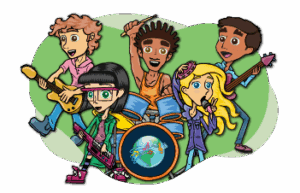 Ravi from India
• Amy from the USA
• Ace from South Africa
• Lin from China
• Oz from Australia
They provide learning role models. They are explorers and storytellers of history, geography and science. They visit countries and cultures, meeting with students in local schools who become their guides.
They share and compare questions and experiences, which is the essence of Questology. In the process, they gain an insight into different ways of life.
Another example is to encourage students to develop their understanding of science through quests. We have done this by creating stories that show how the Can Do Kids Band explores the discovery of each of the 118 elements. For example, in an Element Quest, Ravi or Lin can meet a scientist who is currently using one of the chemical elements to develop new technology. This narrative connection makes the information ‘stick’ in a way that a list of facts never can.
In addition, we have built a facility for students to ask the Can Do Kids Band questions and gain their responses online at candokidsworldwide.com. This generates high interest as students want to see what the band members have to say about the use of chemical elements. We have also extended this educational quest approach to include virtual meetings with major achievers such as William Shakespeare and Marie Curie. Students can pose questions about their work and life, and then write up their views as journalists for the class newspaper.
Constructive Thinking for a New Era
Questology is more than a teaching tool; it is a philosophy of empowerment. By helping students move from critical thinking (which often focuses on what is wrong) toward constructive thinking (which focuses on how to build and solve problems), we prepare them for the complexities of the 21st century.
Questology—how to design, conduct and assess student learning via quests—offers a clear path for teachers to integrate science, literacy and social skills into high-engagement learning.
In a world that is changing faster than ever, we do not need students who can simply repeat what they have been told. We need students with the ‘Can Do’ spirit who ask questions and embark on their own quests. Through Questology, we move from teaching subjects to active learning.
Reference
For a detailed analysis of the pedagogical foundations and research supporting this approach, please refer to: