



In today’s primary classrooms, pupils constantly navigate time and space through their imagination and gain answers via AI.
Questions like:
- “Where is Brazil?”
- “How far is our school from the pyramids of Egypt?”
- “How did the Romans invade Britain?”
These questions demand more than memory. They require mental time travel. This cognitive context perception allows children to mentally project themselves into historic time zones.
Mental time travel helps young minds reconstruct historical events, visualise geographical distances and explore “what if” scenarios.
Involvement and Engagement
It is vital to make the time travel as real as possible. This can be done through role play and re-enactment. For instance, picturing Roman legions landing on British shores is virtual history.
That can be made more realistic by having pupils in two groups discussing how they will respond to the challenge.
We support and supercharge this process by offering many virtual flights through time and space to countries, cultures and events from yesteryear.
Pupils do more than learn the facts. They experience the context through involvement and participation.
Empowering Educators
Mental time travel transforms lessons about people and places into adventures. We do this with primary school pupils from 8 to 11 years via Can Do Kids Worldwide.
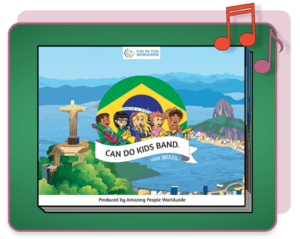 The focus is on learning by exploration. This is done via an animated group of musicians called Can Do Kids Band.
- Lin, the wizard on keyboard, is from China
- Ravi, the cool bass guitarist, is from India
- Amy, the versatile vocalist, is from the USA
- Ace, the dynamic drummer, is from South Africa
- Oz, the adventurous lead guitarist, comes from Australia
They met at an international music camp for young students. With the aid of Dr Wizby, their manager and benefactor, they tour many countries and learn about people and places from fellow students.
Geography Quests
Using Can Do Kids Worldwide’s interactive globe helps pupils to “fly” from their school to many countries, such as:
- Egypt to see the pyramids, calculate distances and explore ancient wonders
- Brazil to explore the rainforest and the Amazon River
- China to visit the Great Wall and understand why it was created
In each place, pupils learn by asking questions. Children who are involved in mental time-travel show a stronger understanding of people and places.
They develop the ability to turn abstract curricula into relatable stories. It is ideal for diverse classrooms, helping all pupils, including those with learning challenges and to connect personally to global narratives.
Amazing People Schools
 Mental time travel is supported through the work we do on character education and wellbeing. We facilitate learning from the way amazing people such as Albert Einstein, Marie Curie or Harriet Tubman worked. We encourage pupils to fly through time to the years when people were making amazing breakthroughs in science, medicine, music and business.
Via Amazing People Schools, pupils can gain readable stories about the lives and achievements of Amazing People, both past and present. In the process, they see that planning, determination, resilience, empathy and courage were all important factors. We encourage pupils to take a proactive approach by asking them to exhibit the key character strengths they noted in the life stories of those they studied.
Supporting Parents at Home
Parents play a vital role in extending these journeys beyond school. With the resources on Brazil, via Can Do Kids Worldwide, discussions on music and dance commence.
By linking home discussions to school topics, parents, through discussion, reinforce learning and nurture their child’s confidence.
Real-World Impact
Integrating mental time travel yields measurable gains such as enhanced motivation, prosocial behaviour and wellbeing, as children learn to anticipate outcomes and reflect on choices.
At Amazing People Schools, we have seen it bridge cultural gaps, from UK history to South American heritage, preparing pupils for an interconnected world.
Summary
Mental time travel equips primary pupils to master time, space, and history through imagination, amplified by online resources and tools. Educators can gain interactive strategies from the websites for engagement.
Parents can do the same and show their interest via discussions with their child. This fosters constructive thinking, empathy and resilience—key skills in an age of rapid change.