



‘We the People’ are the first three words of the Constitution of the United States of America, the founding document of their democracy. This topic is taught in every US school and many more around the world.
 Now, teachers can help students understand the events through active learning. With my colleagues, I developed a series of five-minute music videos on the key events that led to the Declaration of American Independence on July 4th, 1776, and the battles that brought about the establishment of the United States’ first constitutional government in 1789. These videos are used to start classroom group discussions, where students are actively engaged as Patriots or Loyalists.
The Videos and Group Discussions
The first music video highlights the events of 1765. A group called The Sons of Liberty opposed taxes being imposed by politicians in London on the thirteen American colonies, which were ruled by the British Parliament at the time. The Sons of Liberty organised political protests amongst people in the colonies to call for independence.
After showing each video, the teacher allocates students to either a Patriots group or a Loyalists group. If it is a large class, there can be groups of five or six.
 Students are given 15 to 20 minutes to discuss their reasons ‘for and against’ fighting for independence.
Loyalist Groups – Discuss and agree the points you will make to persuade the Patriot groups to continue with colonial rule from the Government of King George III in London.
Patriot Groups – Discuss and agree the points you will make to persuade the Loyalist groups to remove the rule of London’s King George III and to replace it with a new US Government based on democracy.
Each group presents its arguments to the whole class. The aim is to try to convince those on the other side to change their minds and join their group.
The classroom becomes very noisy as the students discuss their points. In the process, they are learning by sharing and comparing views.
Historic Events
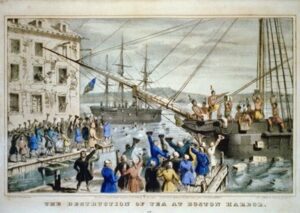 The period covered is from 1765 to 1789, when the first US Government was formed. The events include what is called ‘The Boston Tea Party’, the Declaration of Independence, the battles during the war and the formation of the first US Government. In all, there are 17 videos that can be used on a weekly basis.
Applications
Teachers have used the ‘We The People’ videos and support resources in classes that cover both History and Civics education. The age groups involved range from 9 years to 14 years. The depth of historical detail, vocabulary and evidence expectations can be adapted to suit cohort readiness.
Timetable – Each lesson usually lasts about 50 minutes.
Time | Teacher Actions | Student Actions |
0–5 min | Introduce the episode’s historical focus. Explain that students will work in Patriot & Loyalist groups to debate next steps. | Listen; recall prior learning; note key guiding question. |
5–10 min | Play the 5-minute video. | View; jot quick reactions/evidence. |
10–30 min | Assign/confirm Patriot & Loyalist groups (5–6 students per group recommended for large classes). Provide discussion prompts and remind of criteria (clarity, supporting reasons, attempt to persuade). | In groups, build a case “for” (Patriot) or “against” (Loyalist) breaking from British rule; prepare 2–4 key points and supporting examples. |
30–45 min | Facilitate whole‑class presentations: alternate Patriot and Loyalist groups. | Present; listen; question; respond. |
45–50 min | Debrief: synthesise main historical insights; highlight effective argument strategies; set optional follow-up task or reflection. | Reflect; record learning; complete project work. |
Feedback
Teachers report strong student engagement with the “for vs against” discussion format. Learners participate enthusiastically regardless of the side to which they are assigned, and many enjoy the challenge of arguing a position they do not initially hold. The lively atmosphere translates into deeper content recall, improved confidence in speaking to an audience and richer understanding of democratic debate.
For more information, please go to https://www.wethepeoplelearn.website/